
Dry air storage
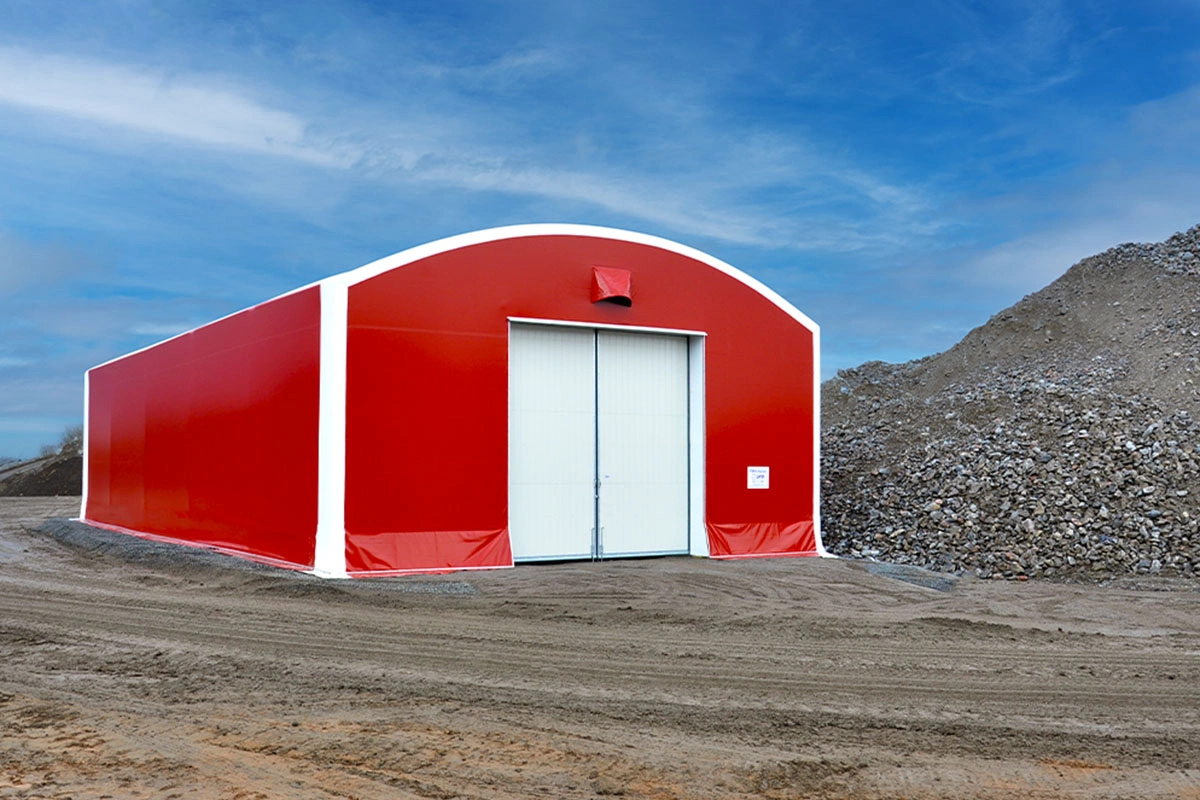
PMH Dry Air Storage is an ideal and energy-efficient solution for storing moisture-sensitive materials. The hall's airtight construction allows the internal environment to be effectively controlled through dehumidification without the need for thermal insulation.
- Guaranteed delivery quality for goods
- Low operating costs
- Prevents corrosion
Dry air storage from PMH has many advantages over conventional buildings. The entire space in the hall is bright because the white PVC roof lets in daylight, and there are no supporting pillars in the middle of the floor because the arched construction helps to stabilize the hall. Dry air storage requires a solid foundation such as an asphalt surface or a concrete slab. We also seal the base/foundation to ensure effective and energy-efficient dehumidification. With a sealed structure and a dehumidification unit, we create the perfect environment for moisture-sensitive materials.

.jpg)
.png)
.jpg)
.jpg)
PMH-Hallen, solving your space requirements
PMH-Hallen, the Swedish-designed warehouse. Market leader for over 40 years! We have a wide range of warehouses and are happy to help you find the most suitable warehouse for your needs.
Warehouse with built-in dehumidification
Dry air storage from PMH has many advantages over conventional buildings. The entire space in the hall is bright because the white PVC ceiling lets in daylight, and there are no load-bearing columns in the middle of the floor because the arched construction helps to stabilize the hall. Dry air storage requires a solid foundation such as an asphalt surface or a concrete slab. We also seal the base/foundation to ensure effective and energy-efficient dehumidification. With a sealed construction and a dehumidification unit, we create the perfect environment for moisture-sensitive materials. The hall is available in several different designs, sizes, and colors.
A dehumidified PMH hall is ideal for storing a variety of materials, such as iron, sheet metal, and aluminum, to prevent corrosion; cardboard packaging, to prevent it from softening and collapsing; and electronics and electrical components, to prevent oxidation. Dry air storage reduces the risk of textiles, wood, leather, and grain becoming moldy and prevents dry products such as cement and artificial fertilizers from sticking together.
How do you ensure the right environment for your moisture-sensitive products?
Many products are sensitive to moisture. Corrugated cardboard, for example, is a material that attracts moisture from the air. For corrugated cardboard to remain in good condition and be stored for long periods, the relative humidity must be below 50%. Untreated steel requires a relative humidity of 50-55% to prevent corrosion. In order to store these types of products, the relative humidity in the storage space must be lowered from the normal level of 70-85%. We use a type of dehumidifier called an adsorption dehumidifier, as it is energy efficient and superior even at low temperatures.
It is important to remember not to leave gates and doors open for too long, as this allows more humid air to enter, which means that the dehumidifier has to work harder. We therefore recommend a motorized gate in a dehumidified hall. Also keep in mind that pallets that have been stored outdoors can contain a lot of water, which also causes the humidity to rise quickly when they are brought into the tent hall.
.jpg)
Dehumidification
Dehumidification is necessary when storing moisture-sensitive materials. The moisture content in the air needs to be reduced in order to ensure the quality of particularly sensitive products such as cement, which readily absorbs moisture from the air, or electronics, which oxidize when in contact with moisture. Humidity is normally between 70-85%, and this needs to be reduced to around 50% in order to achieve the most optimal climate possible. There are various dehumidification methods, and the one we use is adsorption dehumidification. This is an effective and energy-efficient method, where moisture is extracted from the air by the dehumidifier in such a way that there is no need to empty any containers of condensation water, as it is removed with the cold air from the dehumidifier.
Click here to read more about dehumidification.
Sealing
When dehumidifying a tent hall, it is important that the hall is completely sealed to ensure that the dehumidification is as effective as possible. As standard, the hall is sealed against the ground using a pressure-impregnated batten that is fixed to the ground around all sides of the hall. A bitumen-based strip is melted onto the outside of this, forming a channel against the ground that prevents any surface water from running in. The fabric is then attached to the outside of this, sealing the hall.
Operating cost
Dehumidification is a highly energy-efficient technique for achieving a controlled climate. Compared to heating away a moisture problem, energy consumption is a fraction. The dimensioning of the dehumidification unit is based on weather data from SMHI. In winter, the air is drier and energy consumption is minimal.
Pallet rack
Pallet handling with our pallet racks provides great flexibility and efficient logistics in goods handling, regardless of industry. Today, satisfied users include workshops, industrial facilities, and wholesalers' warehouses.
Downloads
Below you can download product sheets, step files, manuals, and other important files related to the product.


.png)
.jpg)


.jpg)